COMMUNITY SERVICE 2
The Repairs No One Sees on a Checklist
Fixing wheelchairs, sitting with residents who were unwell, and learning that the most important repairs at a senior center were rarely the mechanical ones.
Yongin Senior Welfare Center · 2023–Present


THREE THINGS I KEPT DOING, WEEK AFTER WEEK
Hands, hygiene, and company
FIXING WHAT WAS BROKEN
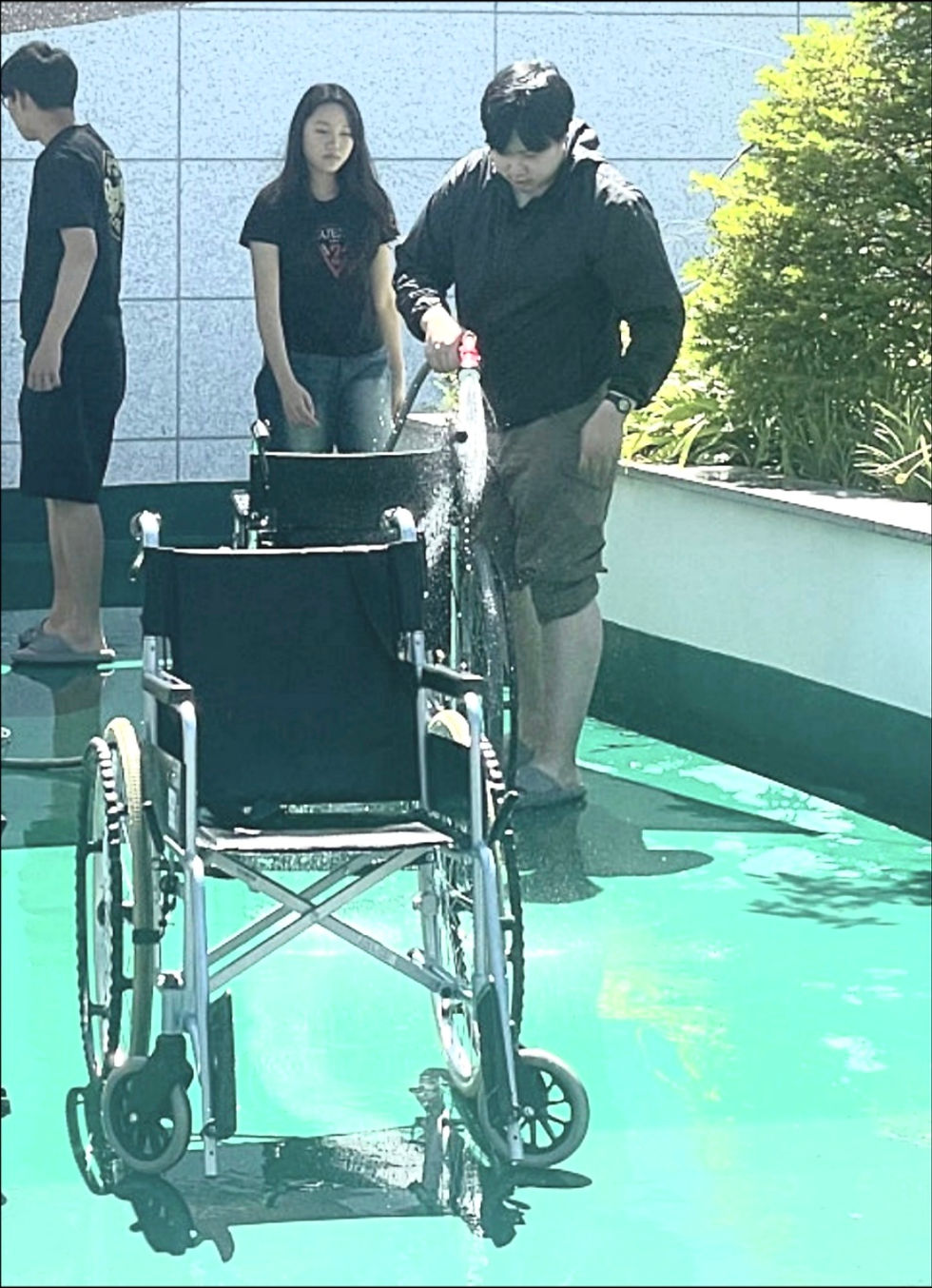
Loose wheels, stiff brakes, a footrest that wouldn't stay locked — the small mechanical failures that make a wheelchair frustrating rather than unusable. I learned to check and repair these myself, one resident's chair at a time.
KEEPING THINGS CLEAN
Wheelchair and bed sanitation isn't glamorous work, but it's the kind of maintenance that determines whether a resident has a comfortable day or an uncomfortable one. I treated it as seriously as anything else I did there.
SHOWING UP FOR THE HARDER PART
Sitting with residents who weren't feeling well. Letting them talk as long as they needed to. Holding a hand when there was nothing left to fix and nothing useful left to say — just someone there.
THE FIRST THING I EVER ACTUALLY FIXED
A wheelchair, a screwdriver, and a lesson in listening to a machine
Nobody taught me how to repair a wheelchair. The first time a wheel wouldn't turn properly, I just knelt down and started looking — tracing where the resistance was coming from, testing each joint until I found the one that was actually the problem. It wasn't sophisticated work. It was the same instinct, at a much smaller scale, that I'd later recognize in every engineering project I took on: don't assume you know what's broken. Find out.
What stuck with me wasn't the repair itself, but who it was for. A wheelchair that rolls smoothly again isn't just a fixed object — for the person sitting in it, it's the difference between moving freely through their day and not.
One grandmother in particular stays with me. Her wheelchair had a problem I couldn't figure out right away — I tried a few things and none of them worked, and I remember genuinely worrying that I might not be able to fix it for her, that she'd be stuck relying on a chair that didn't move the way it should. I kept going back to it anyway, checking each part again, adjusting, testing, until the wheel finally turned the way it was supposed to. When I saw her roll forward smoothly for the first time, and watched how thankful she was — far more than I felt the small repair deserved — it became one of the moments I think about most from my time there. It wasn't the fix itself that stayed with me. It was realizing how much that fix meant to her.
WHAT I DID WHEN THERE WAS NOTHING TO FIX
Sitting with residents who were unwell
Not every visit had a task attached to it. Some of the residents I spent the most time with weren't people I was cleaning for or repairing anything for — they were people who were having a hard day, or a hard month, and just needed someone in the room. I'd sit beside them, listen to whatever they wanted to talk about, and hold their hand when the conversation ran out of words but neither of us wanted to leave yet.
I didn't think of this as volunteering in the usual sense. It didn't produce anything I could point to afterward. But it was the part of every visit I took most seriously, because I could tell — even without anyone saying so — that it mattered more than the chores on the schedule.
There was one grandfather who didn't make that easy at first. He was unwell, and for a long time he barely responded when I spoke to him — short answers, sometimes no answer at all, as if he'd decided it wasn't worth the effort to let anyone in. I kept visiting anyway and kept talking, even when it felt one-sided. Then, without any single moment I can point to as the turning point, something shifted. He started answering. Then he started smiling. Eventually he was the one keeping the conversation going, telling me stories I hadn't asked for because he wanted to share them. I don't think I did anything clever to make that happen. I think I just stayed long enough for him to decide I was worth opening up to — and that took patience, not skill.


Some days I fixed a wheelchair. Other days there was nothing to fix, and the most useful thing I could do was stay in the room anyway.
— on the two kinds of days at the center
WHAT THIS TAUGHT ME BEFORE I EVER SET FOOT IN A LAB
What I took from it
Looking back, the wheelchair repairs were my first real experience with hands-on, physical problem-solving — the kind where you can't rely on a manual, and the only way forward is to examine the thing carefully enough to understand exactly where it's failing. That habit followed me directly into my later research: measuring the electrical characteristics of ferroelectric devices at the University of Virginia, or testing photodiode sensors for the artificial compound eye project, I found myself doing the same thing I'd done kneeling next to a wheelchair — checking, rechecking, and refusing to trust a result until I understood why it looked the way it did.
But the harder lesson was the one that had nothing to do with fixing anything. Sitting with someone who was unwell, with no task to complete and no problem I could actually solve, taught me that not every kind of care looks like engineering — and that being useful to someone sometimes just means being present. I think that's part of why the technology I'm most drawn to isn't technology for its own sake. It's technology built around a person whose actual needs I took the time to understand first — the same instinct I first practiced holding a hand in a quiet room at the welfare center, long before I ever picked up a soldering iron.