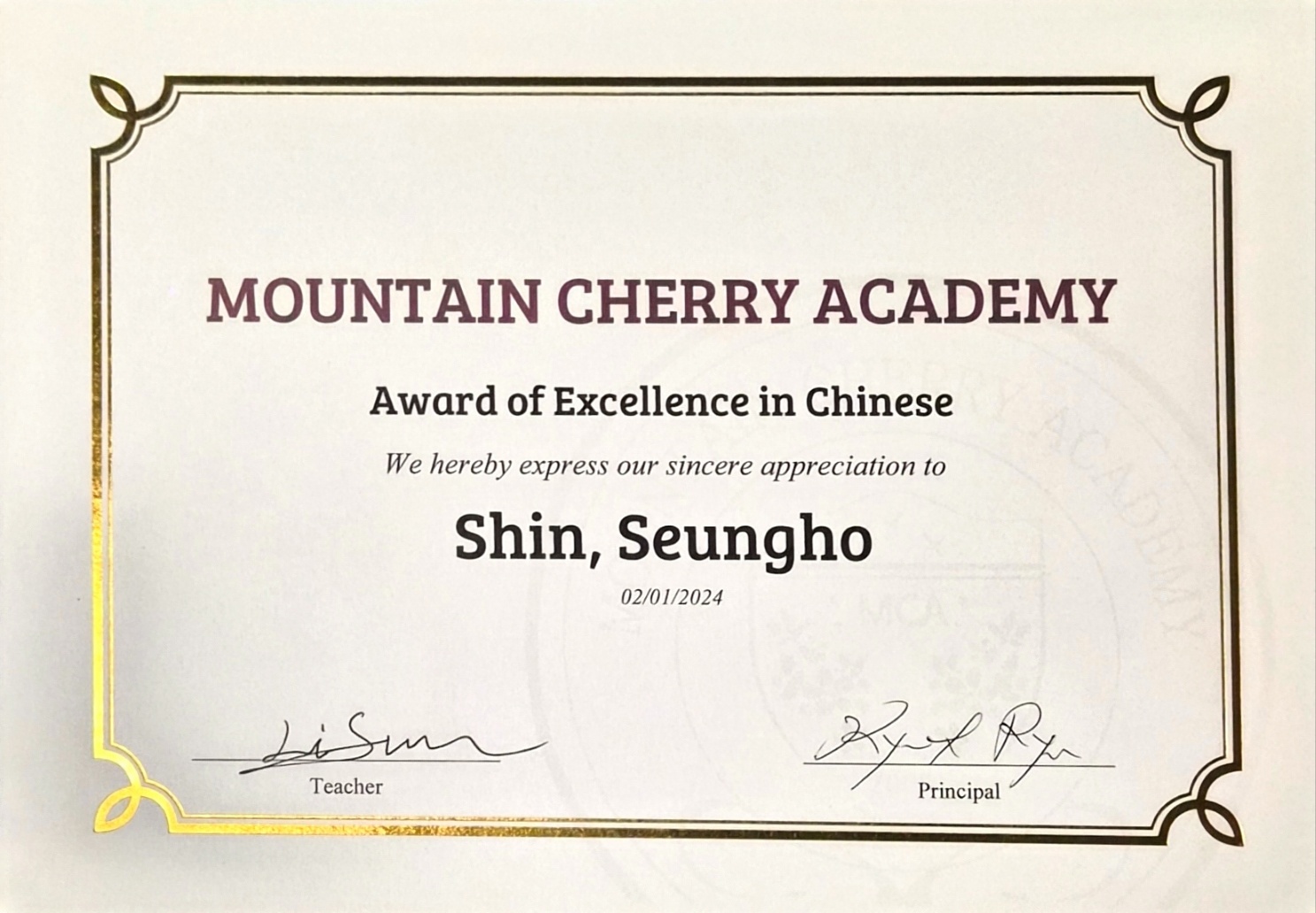
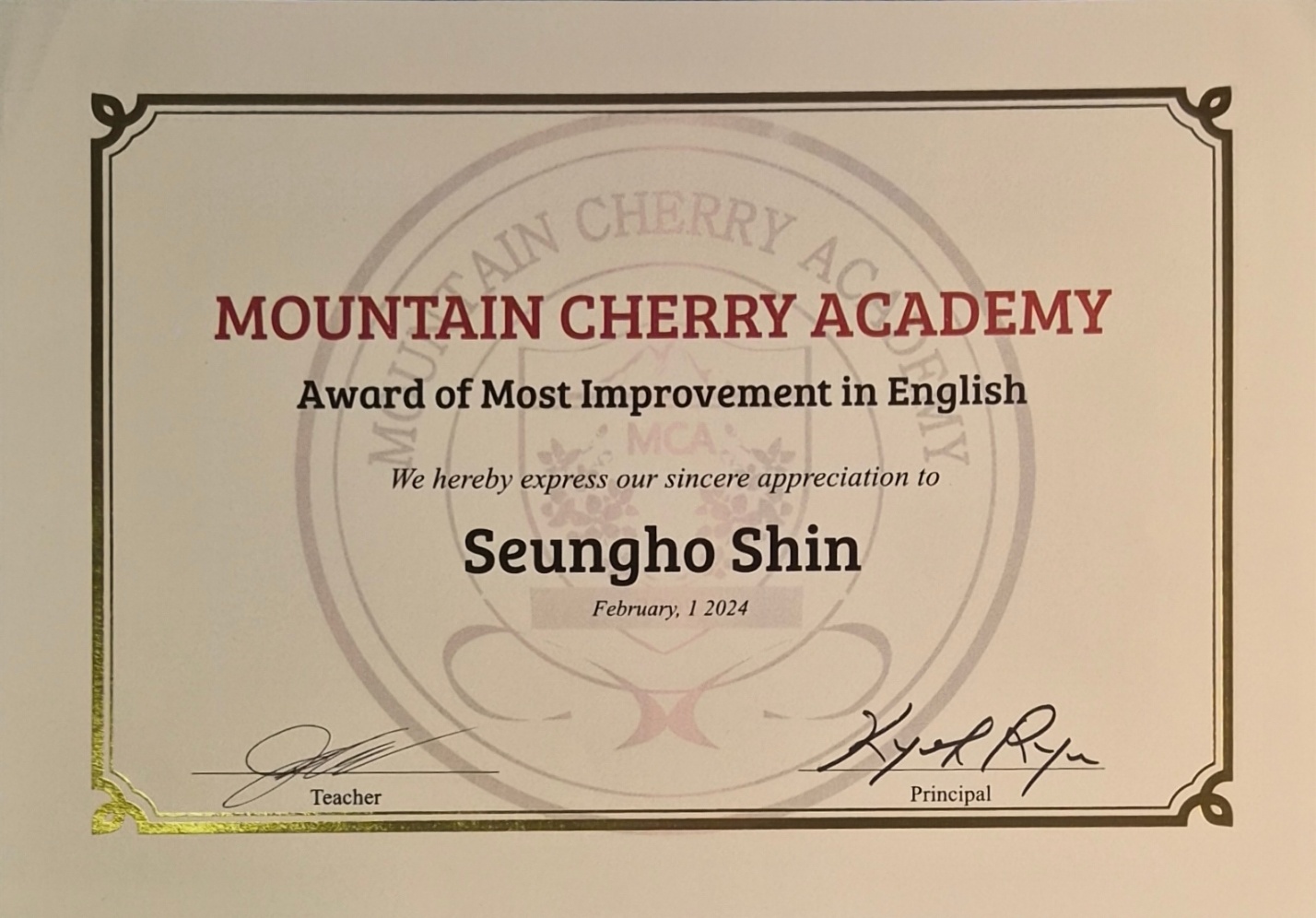
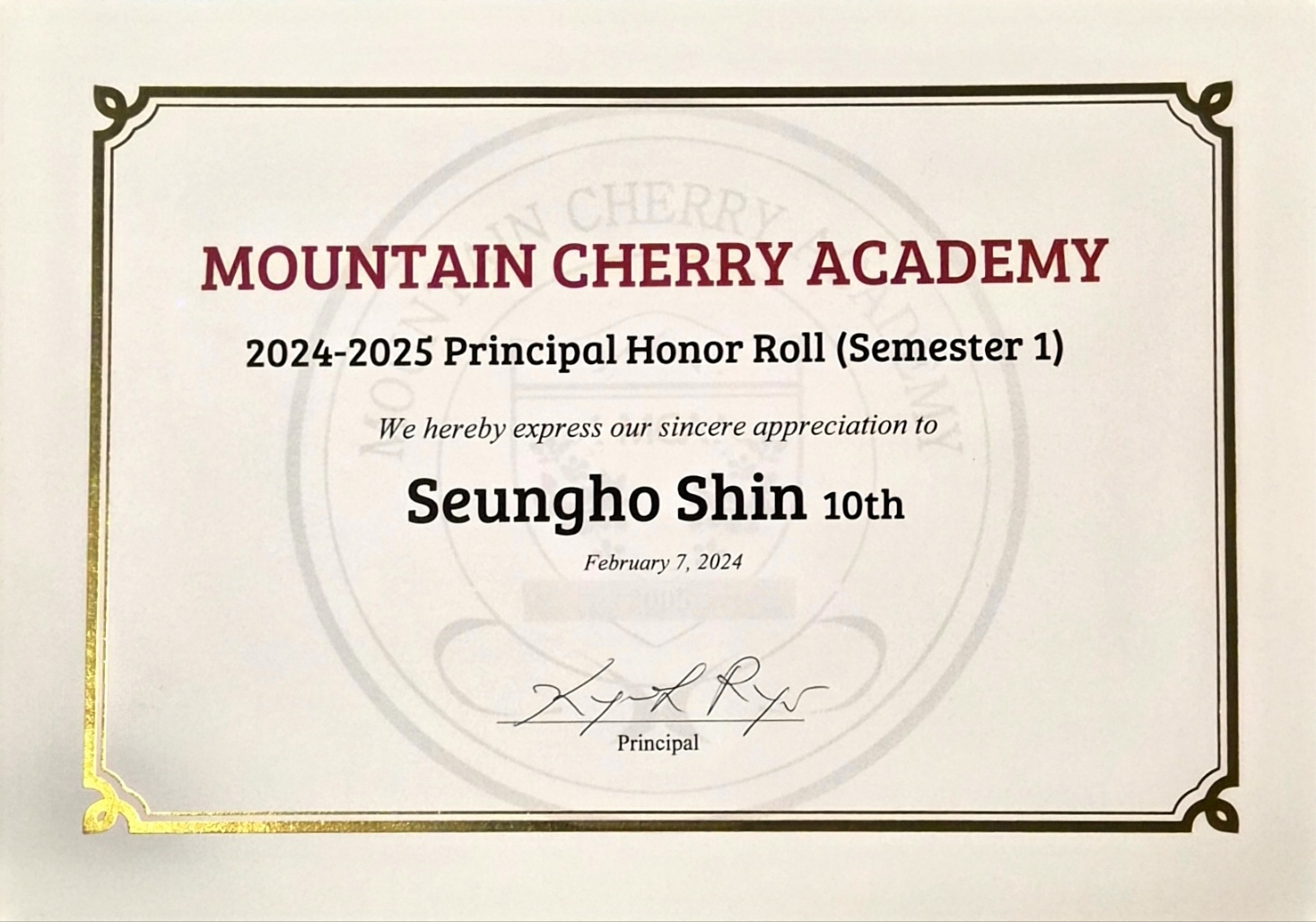
🏆External Competition
-
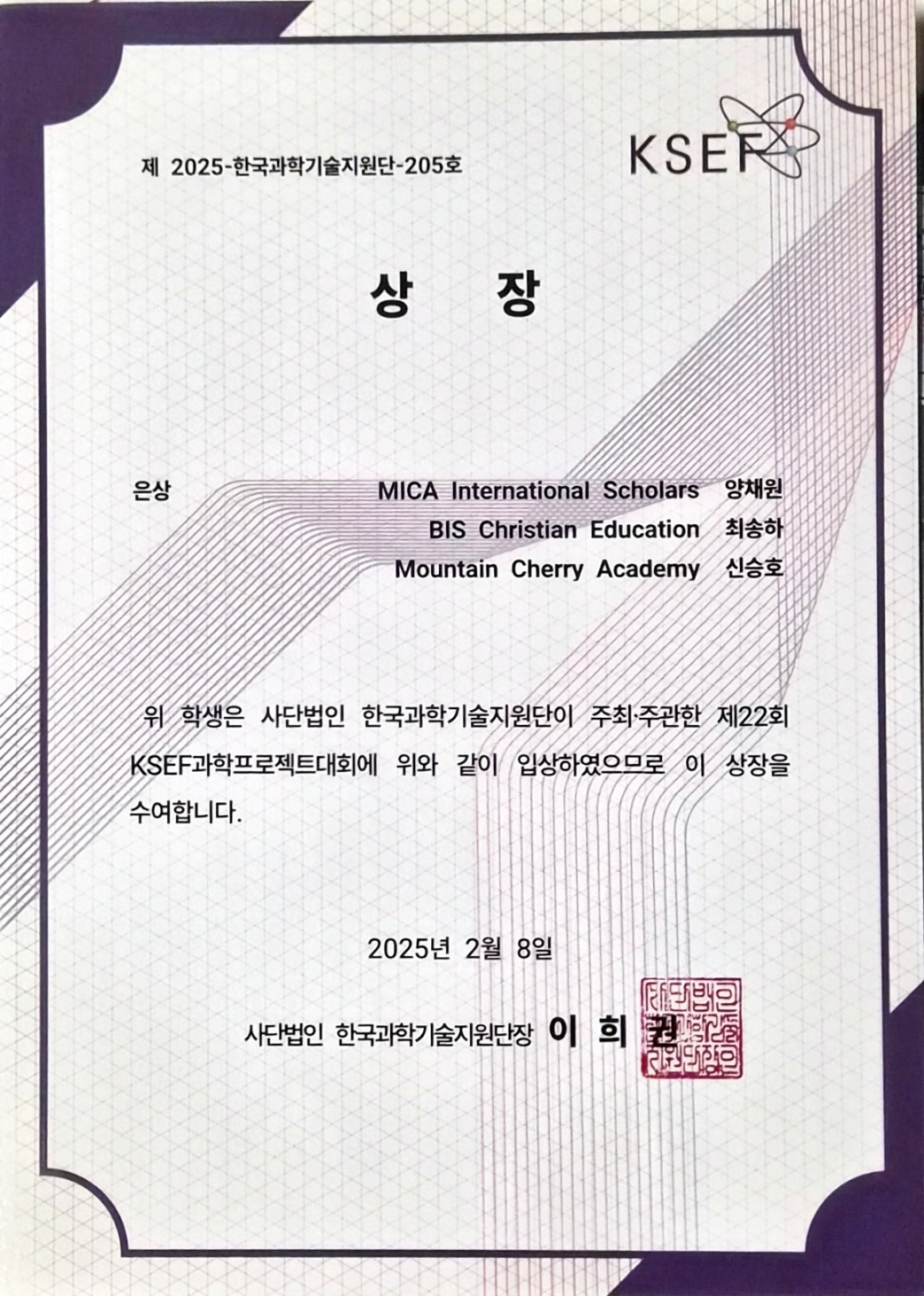
22nd KSEF Science Project Competition — Certificate of Award
-
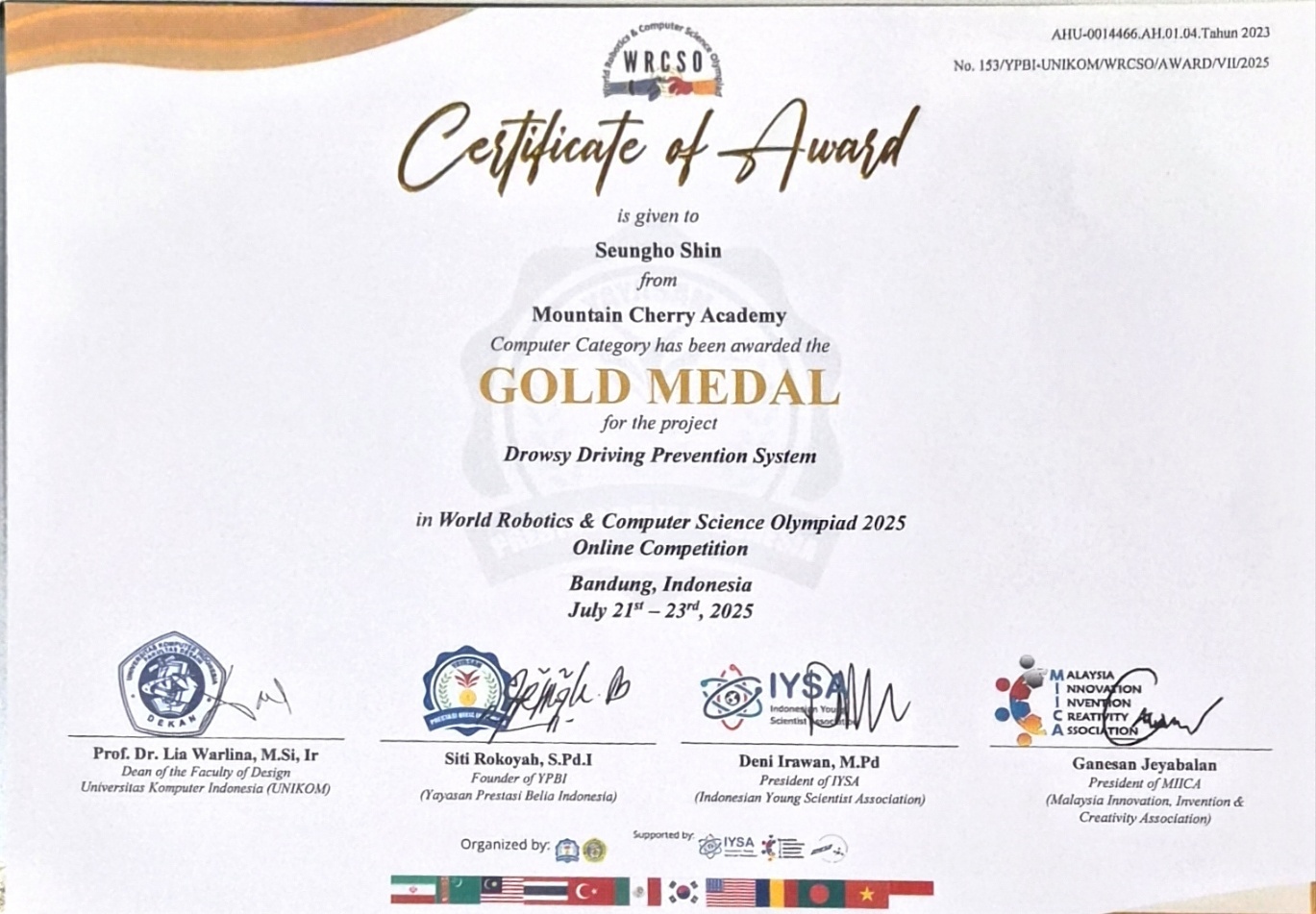
World Robotics & Computer Science Olympiad 2025 — Gold Medal
-
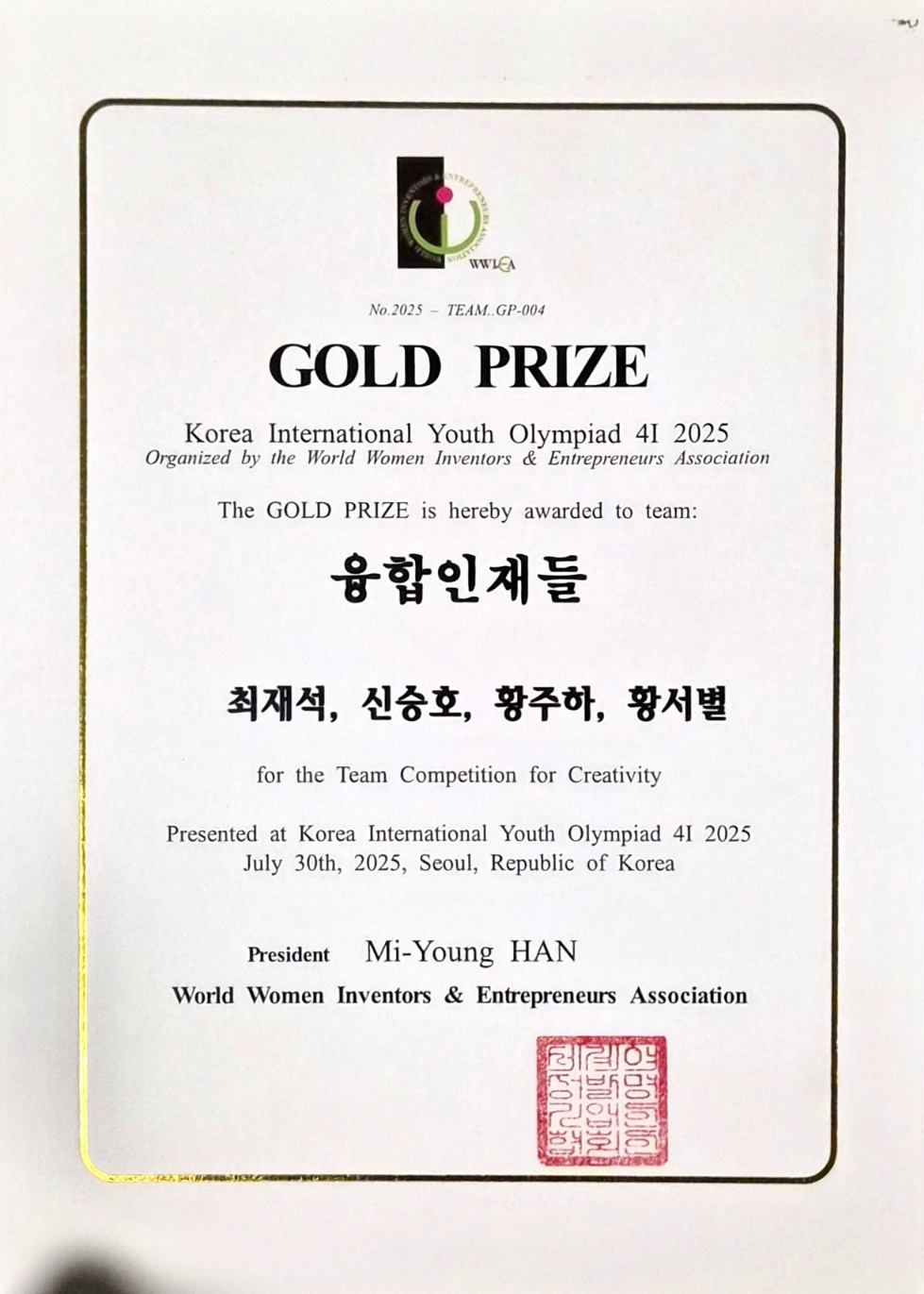
Korea International Youth Olympiad 4E — Gold Prize
-
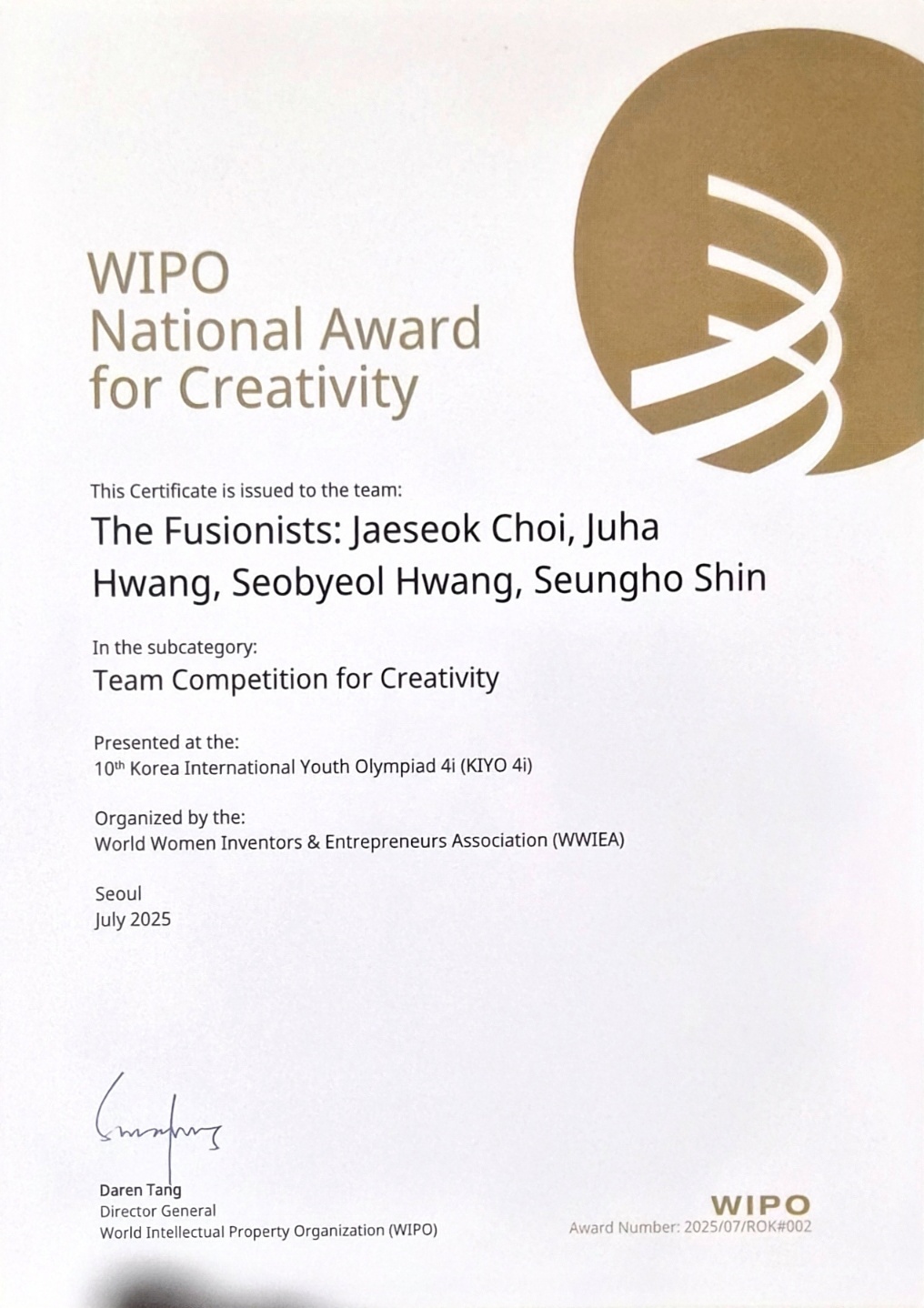
WIPO National Award for Creativity — Gold Award
-
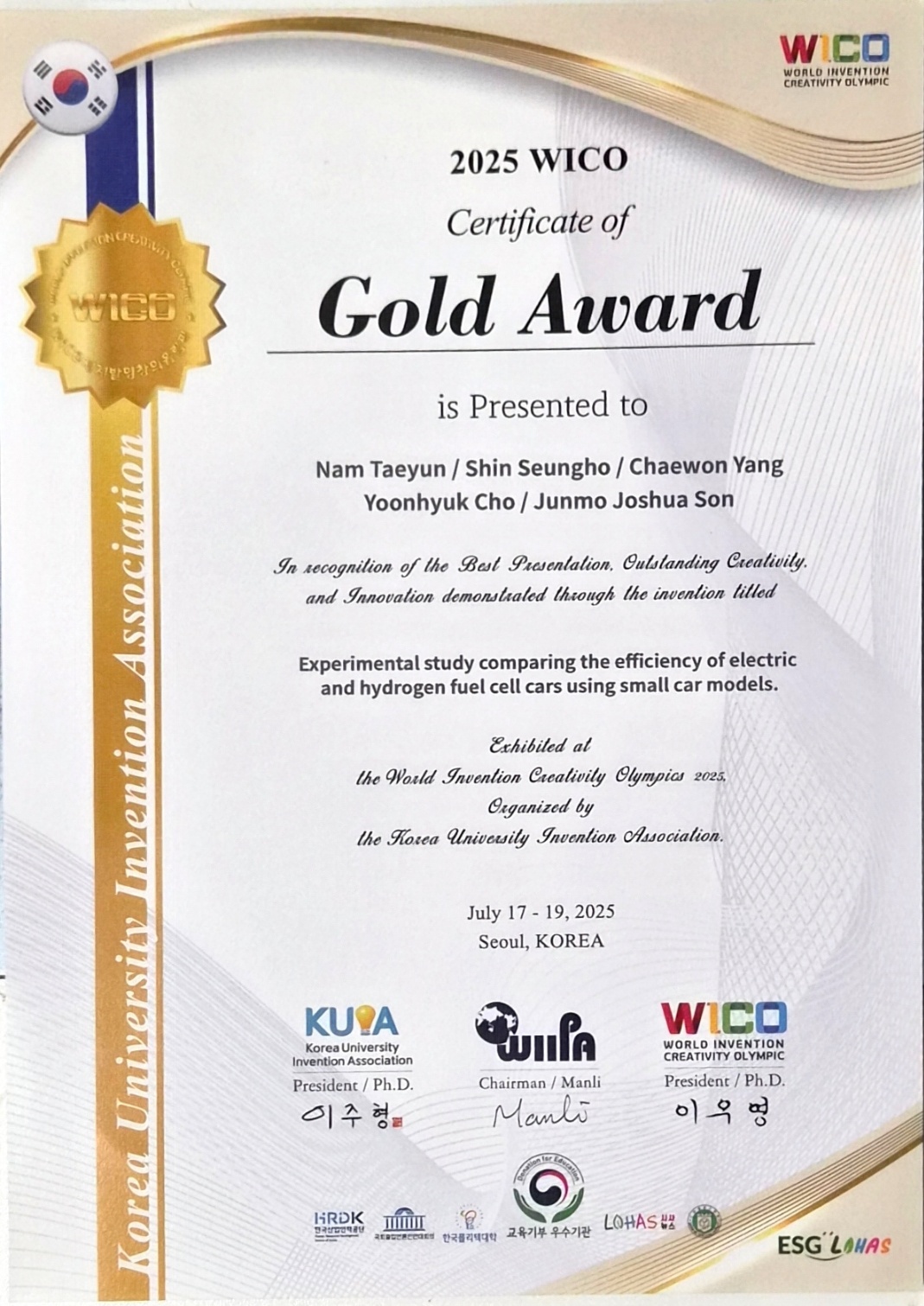
2025 WICO — Gold Award
-
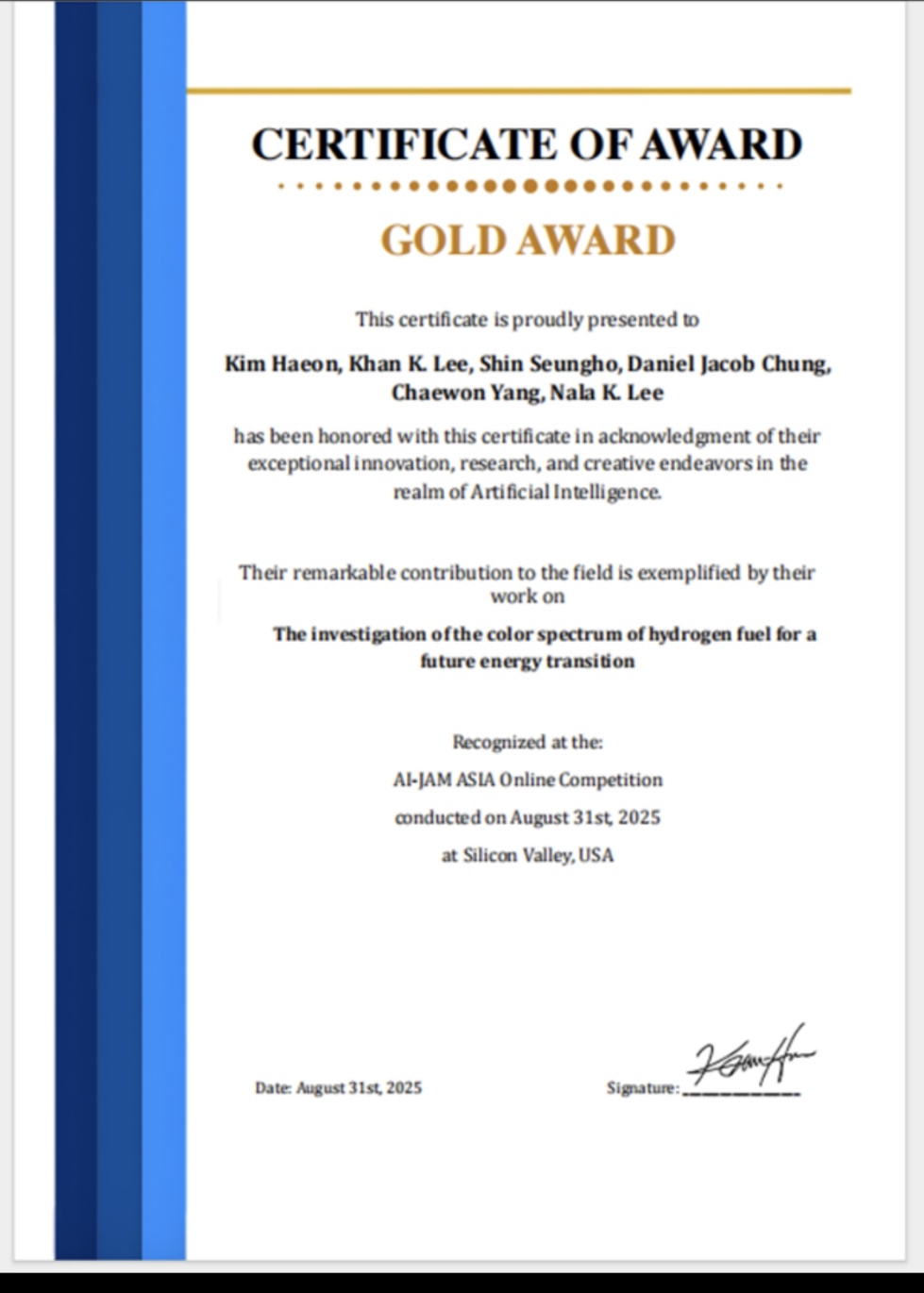
AIJAM — Gold Award
-
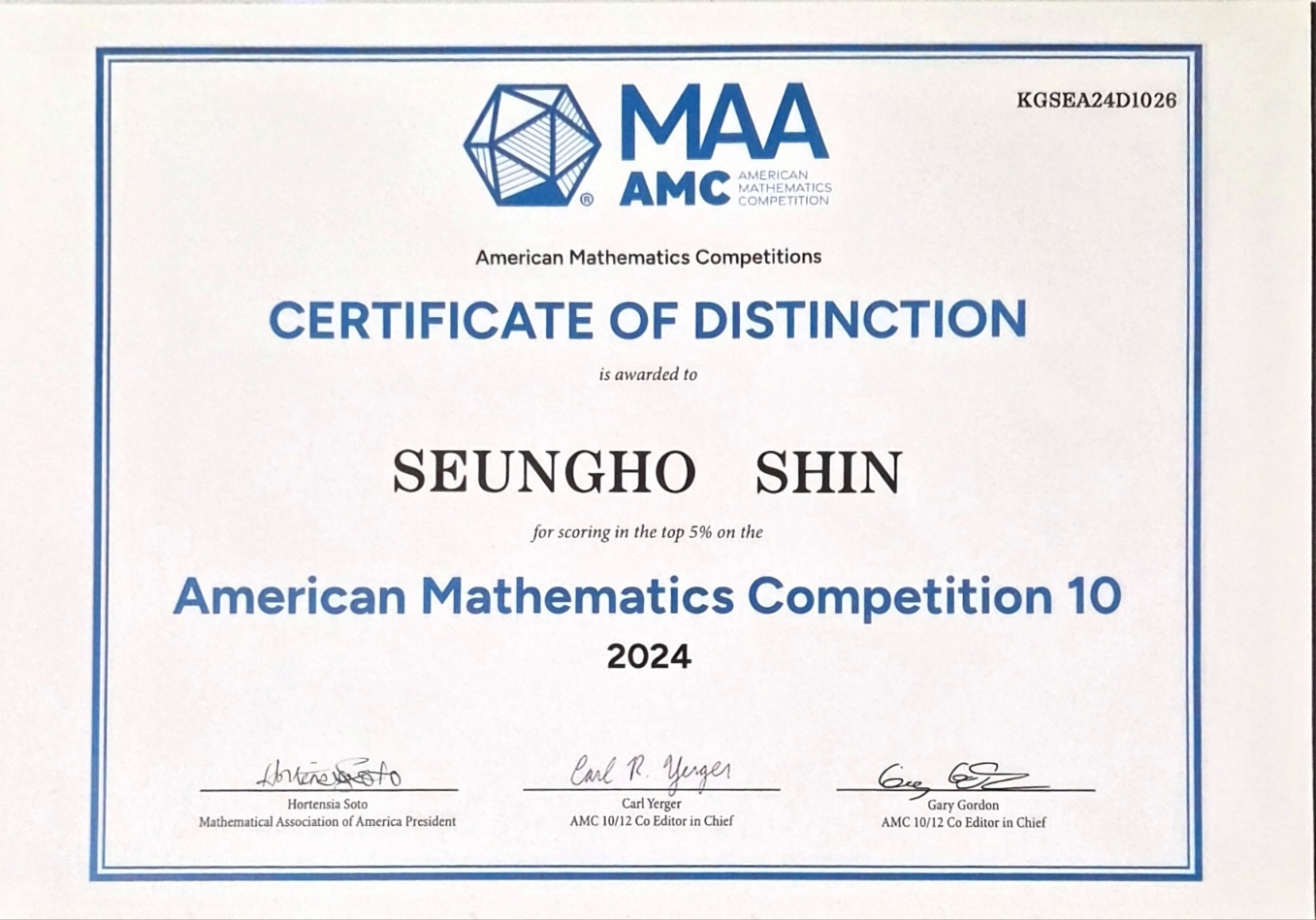
American Mathematics Competition 10 (2024) — Certificate of Distinction
-
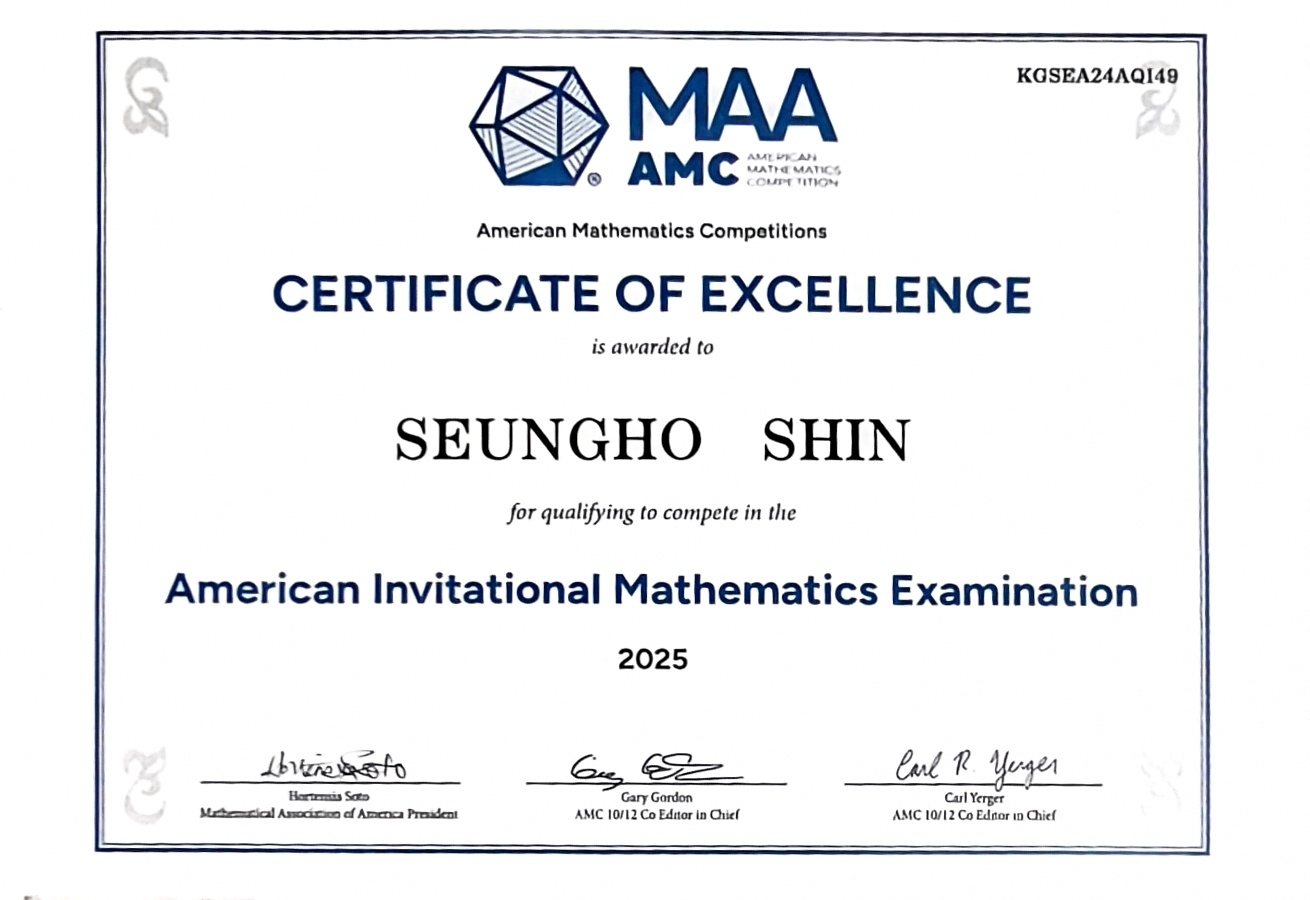
American Invitational Mathematics Examination (2025) — Certificate of Excellence (AIME qualification)
-
AIJAM 2026 — ESG Management Research
-
Can 2026 — Social Policy Research
-
WICO 2026 (Indonesia) — Environmental Research
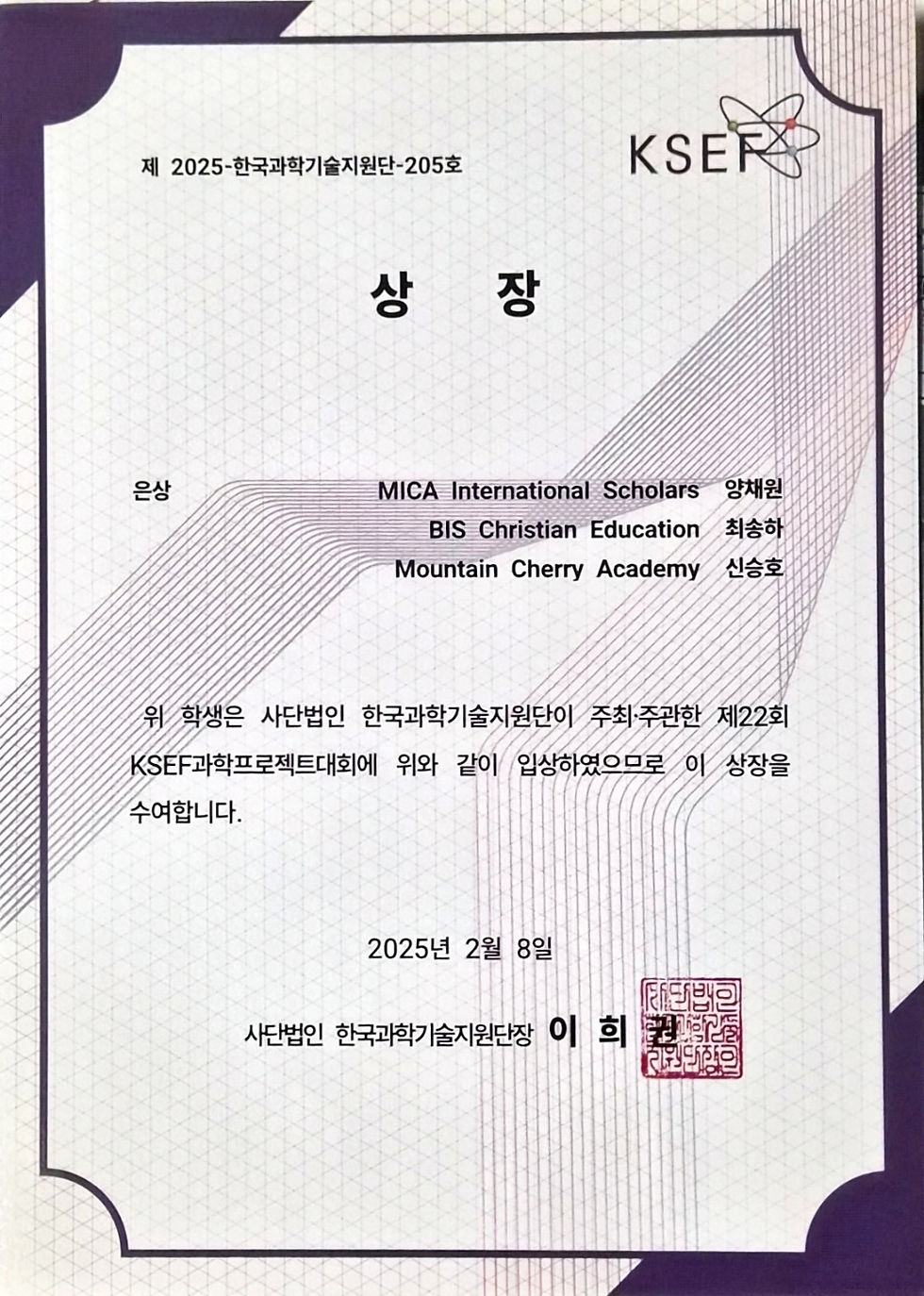
1. KSEF — 22nd Science Project Competition — Certificate of Award
HarmonyMind: Text-Based Emotion Analysis and AI Music Creation for Psychological Care
(with Chae-Won Yang, Song-Ha Choi)
We built a system that reads a piece of text — a diary entry, for example — analyzes the emotion behind it using an LLM, and generates original music tailored to that emotional state in real time. We benchmarked GPT 4-o, Gemini, and Claude 3 against a 7-emotion, 350-sample Korean dataset from AI-Hub; GPT 4-o came out on top with 99.4% accuracy and became our emotion-analysis engine. For music generation, we compared MUSICGEN against Stable Audio Open using cosine similarity between text and audio embeddings (via the Pengi model), and Stable Audio Open won clearly — a 68% match rate versus 32%. We combined both into a working pipeline: write a diary entry, get music built around how you actually feel.
What I felt / how I grew:
This was the first project where I had to defend a model choice with a number instead of a hunch. Before this, "which AI is better" felt like a matter of taste — after running the same 350 prompts through three different LLMs and watching the accuracy gap show up in black and white, I understood that evaluation itself is a skill, not an afterthought. It also reframed how I think about emotion and technology together: music generation isn't just a technical output, it's supposed to land on a person in a specific state. That shifted how carefully I now think about the human on the other end of anything I build.
.jpeg)
2. World Robotics & Computer Science Olympiad 2025 — Gold Medal

Smart Alert AI: A Cellphone-Based Real-Time Drowsy Driving Prevention System Using YOLO and Conversational AI (with Chae-Yun Jung, Jae-In Lee)
Drowsy driving causes about 15% of all traffic accidents in Korea and carries roughly twice the fatality rate of an average crash — and existing prevention systems mostly rely on expensive embedded sensors or simple beeping alarms that lose effectiveness fast. We built a system that runs on a plain smartphone: a YOLO11m model trained on 100,000+ driver-state images from AI-Hub detects nine facial indicators (eye state, mouth state, yawning, phone use) in real time (mAP50 61.3%, Recall 86.5%), while a conversational AI keeps the driver alert through natural dialogue rather than a one-off alarm. We cross-evaluated OpenAI o1, Claude 3.5, and Gemini 2.0 by having each model grade the others' conversational responses — Claude 3.5 won decisively (41/60 points) and became our conversation engine, integrated with the Model Context Protocol (MCP) to pull in real-time traffic and weather context.
What I felt / how I grew:
This was the project where I first had to make two very different technologies — computer vision and conversational AI — actually work together instead of side by side. Getting the YOLO detection loop to talk to the LangChain conversation system in real time, without lag breaking the illusion of a natural conversation, was the hardest integration problem I'd faced. It also taught me something about evaluation design: having the LLMs grade each other, rather than trusting a single benchmark, felt like a more honest way to surface a model's real conversational quality — a lesson in designing your own test rather than accepting the obvious one.
3. Korea International Youth Olympiad 4E — Gold Prize

Protecting the Authenticity of Human Art in the Age of AI: Developing an Emotional-Trace Verification System
As a team, we tackled the problem of AI displacing human artists using KIYO's four-step problem-solving framework: identify the problem, brainstorm freely, select and refine a solution, then apply and iterate. Our institutional-level proposal covered mandatory AI-content labeling, a certification mark for human-made art, and a "creation tax" on commercial AI content to fund artist support. But our team's original contribution was a technical one: capturing the physical and biometric traces that only a human leaves behind while creating — hand tremor, pen pressure, heart rate, breathing, ambient sound — through digital pens and wearables, then registering that data on a blockchain so it can't be forged. We stress-tested the idea by asking friends, teachers, and family what could go wrong (accessibility of the sensors, public understanding of the concept) and folded their feedback into a simplified, app-based version of the recording system.
What I felt / how I grew:
This was the first time I worked on a problem that had no clean engineering answer — you can't really "solve" the value of human creativity with a sensor. What stuck with me was realizing that a good technical solution still needs a policy layer around it to actually work in the real world; the blockchain idea meant nothing without the certification and taxation framework holding it up. Presenting an idea to non-technical people (our own teachers and parents) and having them poke holes in it — gently, but effectively — also taught me that a solution isn't finished until it survives someone asking "but what if..." out loud.
4. WIPO National Award for Creativity — Gold Award
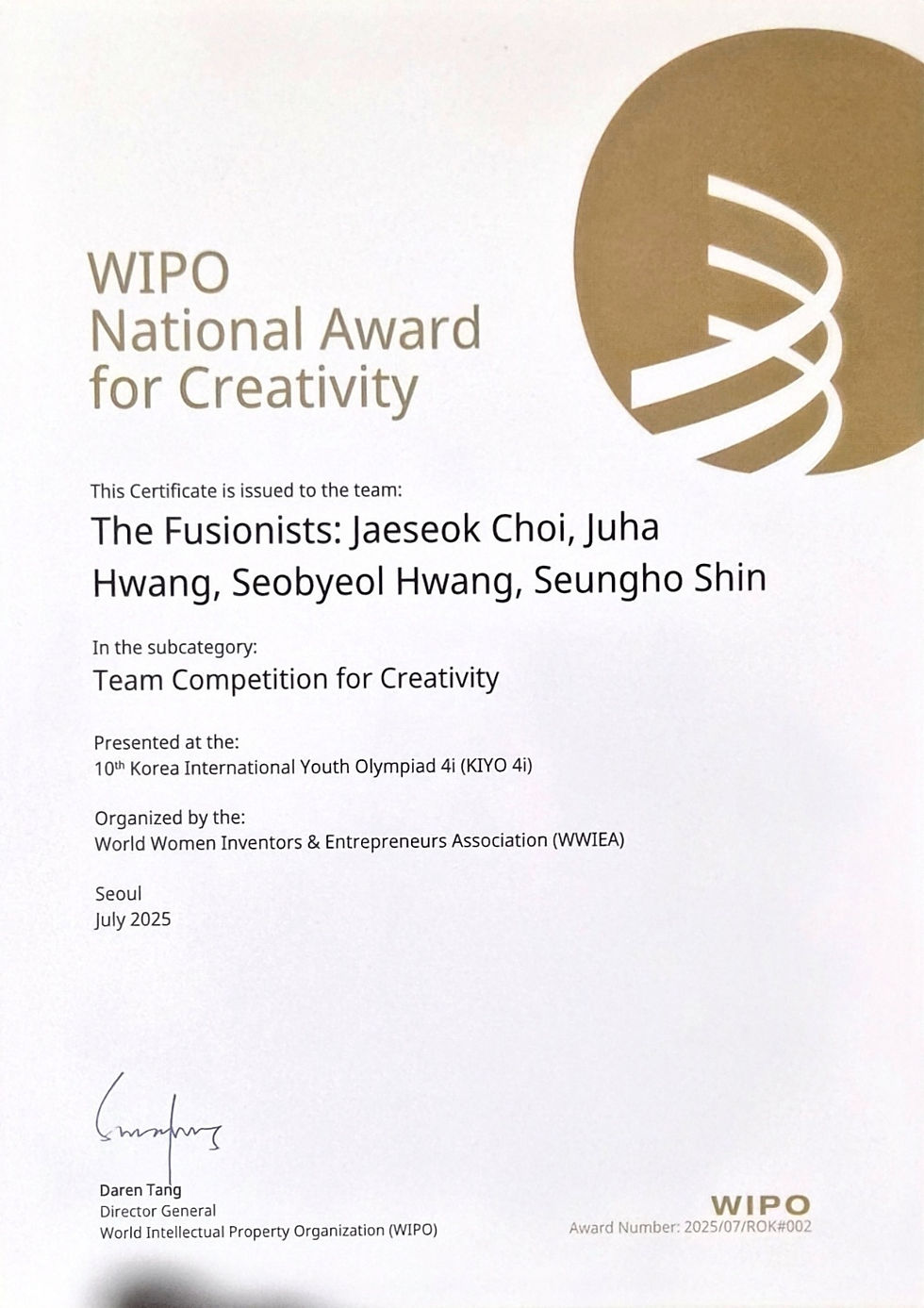
This award was presented by the World Intellectual Property Organization (WIPO) as a special creativity honor given out within the 10th Korea International Youth Olympiad 4i (KIYO 4i) — the same competition, same team, and same project that earned our Gold Prize in the Team Competition for Creativity category. In other words, this wasn't a separate submission: it's a distinct award WIPO layered on top of the main KIYO 4i competition, recognizing our project — "Protecting the Authenticity of Human Art in the Age of AI: Developing an Emotional-Trace Verification System" — specifically for its creative merit.
5. 2025 WICO (World Invention Creativity Olympic) — Gold Award

Experimental Study Comparing the Efficiency of Electric and Hydrogen Fuel Cell Cars Using Small Car Models
What started as curiosity over an assembled hydrogen fuel-cell toy car turned into a real efficiency study. I used a water electrolysis apparatus to generate hydrogen, measured the electrical energy input against the chemical energy produced, and compared the efficiency of an old hydrogen fuel-cell car, a newly developed one, and a conventional electric car. The newer fuel cell model showed roughly 30% higher efficiency than the older one. I also tested how water temperature (0°C, 20°C, 40°C, 60°C) and electrolyte concentration (0.3% saline) affected hydrogen output — water that was too cold or too hot lowered efficiency, and impurities degraded the membrane, cutting output significantly. The clearest takeaway: distilled water is best, and there's a real optimum temperature range.
What I felt / how I grew:
This was my first experience designing and running a physical experiment completely on my own, from the electrolysis setup to the stopwatch measurements. What surprised me was how much patience it required — timing gas generation across five different conditions, one variable at a time, taught me to trust incremental, careful data over a single dramatic result. It's the same instinct I later recognized in the wheelchair repairs at the welfare center: don't assume, measure. This project is probably where that habit actually started.
6. 2025 AIJAM — Gold Award

The Investigation of the Color Spectrum of Hydrogen Fuel for a Future Energy Transition
A literature-based study classifying hydrogen production methods by their environmental "color": grey (fossil fuels, no carbon capture), blue (fossil fuels with carbon capture and storage), turquoise (methane pyrolysis, producing solid carbon instead of CO2), and green (electrolysis powered by renewables). I compared their relative greenhouse gas emissions and production economics — currently 96% of global hydrogen is grey, but falling costs for renewable electricity and electrolyzers suggest green hydrogen will eventually undercut blue hydrogen on cost. I also looked at ammonia as a hydrogen carrier and briefly covered emerging natural "white hydrogen" deposits as a possible future source, aiming to sketch out a realistic technology roadmap toward a net-zero energy system by 2050.
What I felt / how I grew:
This project pushed me to actually sit with dozens of academic sources instead of a handful — synthesizing that much conflicting information (some sources optimistic about blue hydrogen, others skeptical) into one coherent argument was harder than any lab experiment I'd done. It taught me that research writing isn't just reporting facts, it's making a judgment call about which evidence to trust and why, and being honest about the uncertainty that's left over. I came away from it far more comfortable holding a position while still admitting what I don't know for certain.
7. American Mathematics Competition 10 (2024) — Certificate of Distinction
.jpeg)
Awarded by the Mathematical Association of America for scoring in the top 5% of all participants on the AMC 10.
8. American Invitational Mathematics Examination (2025)
— Certificate of Excellence

Qualified for AIME by placing among the top scorers on the AMC 10 — a distinction reached by only a small fraction of all participants.
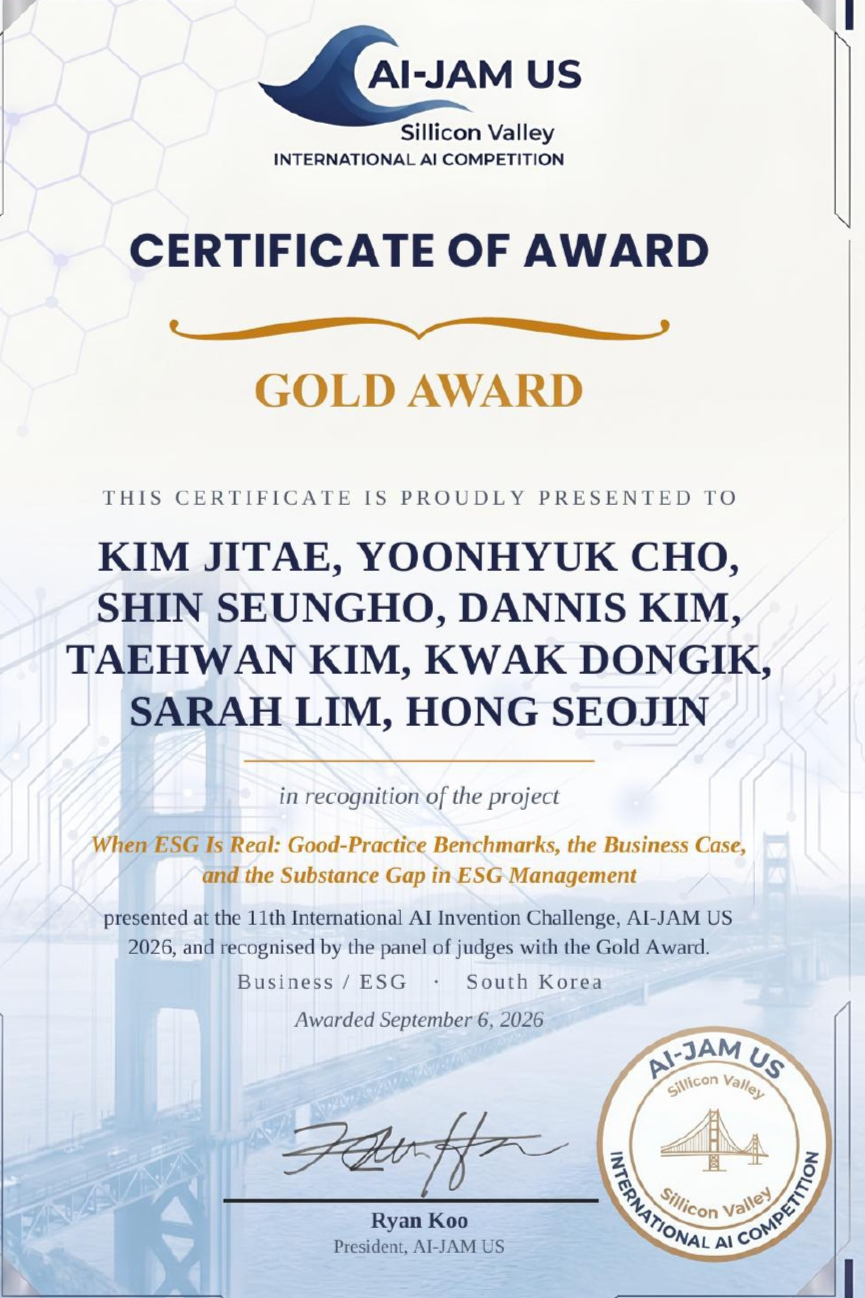
9. AIJAM 2026 — ESG Management Research

When ESG Is Real: Good-Practice Benchmarks, the Business Case, and the Substance Gap in ESG Management
With the SPC Group as a Cautionary Baseline and Updated 2024–2026 Evidence
ESG-related assets under management passed US$40 trillion in 2025, and mandatory sustainability reporting arrived the same year under the EU's CSRD and the ISSB standards — but publishing an ESG report isn't the same as practising ESG. This paper uses South Korea's SPC Group as a cautionary baseline: a company that reported itself as socially responsible while accumulating failures across all three pillars (unhygienic Dunkin' factories, a worker's death in 2022, coerced pregnant-worker contracts, unlawful trade-union coercion). I ran a 50-person survey that found wide awareness of the resulting boycott (80%) but thin active participation (20%) — and SPC's share price and annual net profit both proved resilient, showing how a weak short-run market signal can mask real reputational and human costs. Against that baseline, I assembled the evidence that substantive ESG does create value: NYU Stern's meta-analysis of roughly 1,400 studies found a positive ESG–financial relationship in 58% of corporate studies and negative in only 8%, concentrated in long horizons and crisis-time downside protection — but only when ESG is a strategy rather than mere disclosure. I then benchmarked genuine leaders (Microsoft's carbon-negative-by-2030 pledge, Ørsted's coal-to-offshore-wind pivot, Schneider Electric and NVIDIA's top ratings, Patagonia's transfer of ownership to a purpose trust) and mapped the "substance gap" that separates them from reporting-heavy laggards.
What I felt / how I grew:
This was the first research I'd done where the subject wasn't a device or a model but a company's behaviour — and where the most important finding was uncomfortable rather than clean. I expected the boycott data to show consumers punishing a company that had hurt its workers; instead it showed most people knew and didn't act, and the company's profits went up. Sitting with that instead of arguing it away taught me something about intellectual honesty: the point of research isn't to confirm what you hoped, it's to report what the numbers actually say and then explain why. Running a survey with real respondents also made me far more careful about how a question is worded — several respondents couldn't identify which brands SPC actually owned, and that alone explained a large part of the result.
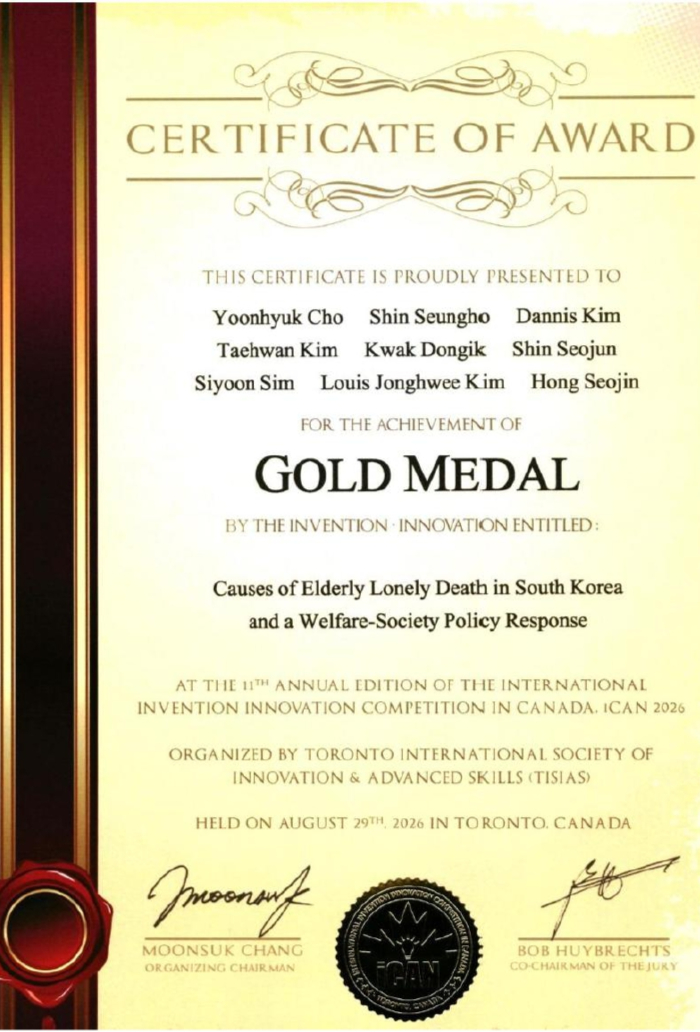
10. Can 2026 — Social Policy Research

Dying Alone in a Super-Aged Nation: Causes of Elderly Lonely Death in South Korea and a Welfare-Society Policy Response
A regional-risk index (LDR) reassessed with 2024–2025 data
South Korea is ageing faster than any nation in recorded history — it crossed the 20.3% "super-aged" threshold in December 2024, ahead of projections — and one of the starkest symptoms is godoksa, dying alone and being found only after time has passed. Building on a prior study's Loneliness Danger Rating (LDR) index — a standardized weighted composite of the elderly living-alone rate, the elderly suicide rate, and the inverse of the welfare-facility rate — I updated the framework with the latest national figures and re-examined what it reveals. Applied across 243 municipalities, the index ranked mountainous, rural Gangwon Province highest-risk: terrain that thins social contact, relatively high poverty, and sparse welfare facilities, all compounding. Korea's elderly relative poverty rate (39.8% in 2023) is the highest in the OECD at roughly 2.7× the average, driven above all by an inadequate public pension. From that diagnosis I proposed a five-pillar welfare-society agenda — income security, social connection, mental health, regional equity, and governance — grounded in Korea's existing Basic Pension, Long-Term Care and 2021 Lonely-Death Prevention Act, and in international models like the UK's and Japan's loneliness ministries and Seoul's "Without Loneliness" plan.
What I felt / how I grew:
This is the research project closest to the four years I spent at the senior welfare center, and writing it changed how I understood that time. The people I sat with every week were, in statistical terms, exactly the population this index is built to find — and seeing that turned into a number on a map was genuinely strange. What I took from it is that a composite index is only useful if you can name what each component actually means in someone's life: the "welfare-facility rate" isn't an abstraction, it's whether someone has anywhere to go. It also taught me to be careful with my own framing — the data showed that middle-aged men, not the elderly, are the single largest group, and I had to revise a conclusion I'd already written rather than quietly leave the nuance out.
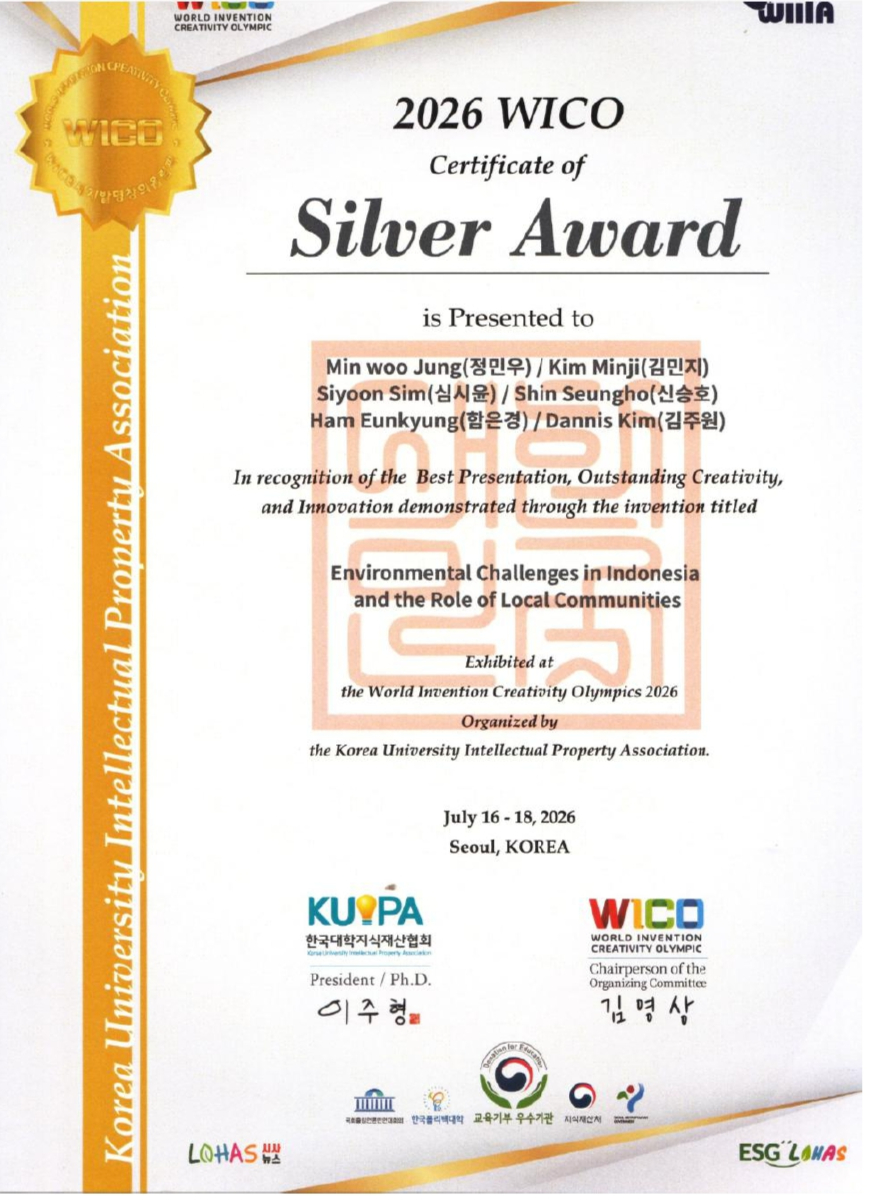
11. WICO 2026 (Indonesia) — Environmental Research

Environmental Challenges in Indonesia and the Role of Local Communities: A Data-Driven Review of Marine Plastic, Air Pollution, and Community-Based Responses
(with Minwoo Jung, Siyoon Sim, Eunkyung Ham, Dannis Kim, Minji Kim)
Indonesia releases roughly 1.29 million tonnes of plastic into the ocean each year, its capital recorded 2024 average PM2.5 of 41.7 µg/m³ (about 8.3× the WHO guideline), and it generated 33.79 million tonnes of municipal waste in the same year — half of it from households. Our team reviewed the scale and drivers of those pressures, then analyzed something we found more interesting than the problem itself: Indonesia's unusually rich ecosystem of community-based environmental management. Household waste banks (Bank Sampah), where residents sort recyclables and receive payment credited like a bank deposit, now involve on the order of 350,000 households. Volunteer river clean-ups intercept plastic on the main highway to the sea. Social forestry — where the government grants communities legal rights to manage designated forest — covers 8.4 million hectares and 1.4 million families, and community mangrove restoration works toward a 600,000-hectare national target, the world's largest. We argued these mechanisms work because they convert environmental burdens into local income, but remain constrained by volatile recyclables markets, weak collection infrastructure, and uneven policy coverage — concluding that durable progress requires co-management, where national policy scaffolds rather than replaces community action.
What I felt / how I grew:
I went into this expecting the answer to be technology or regulation, and the evidence kept pointing somewhere else: the most effective mechanism in the whole review was a neighborhood system where people get paid small amounts for sorting their own trash. That reframed something for me about how solutions actually scale — the social forestry program worked not because it was clever but because it gave people a legal right and a reason to care. Researching a country I've never lived in also forced a kind of humility; I had to rely entirely on national statistics and local literature rather than intuition, and be honest in the conclusion about what our review could and couldn't quantify.







🎖️School Contest
-
MCA 2023-24 Yearbook Cover Design — Grade Level Winner (G9)
-
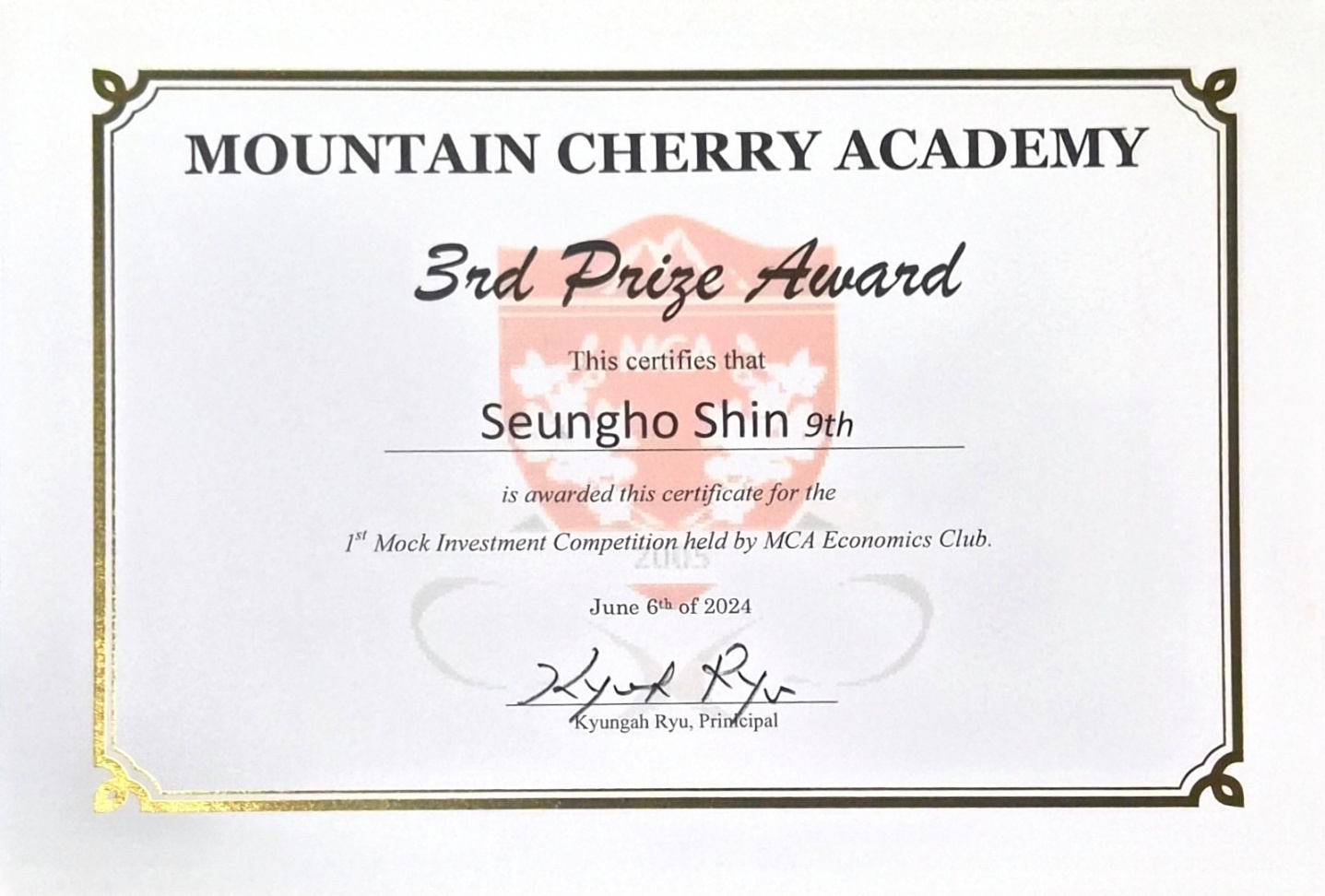
1st Mock Investment Competition (MCA Economics Club) — 3rd Prize Award (9th grade)
-
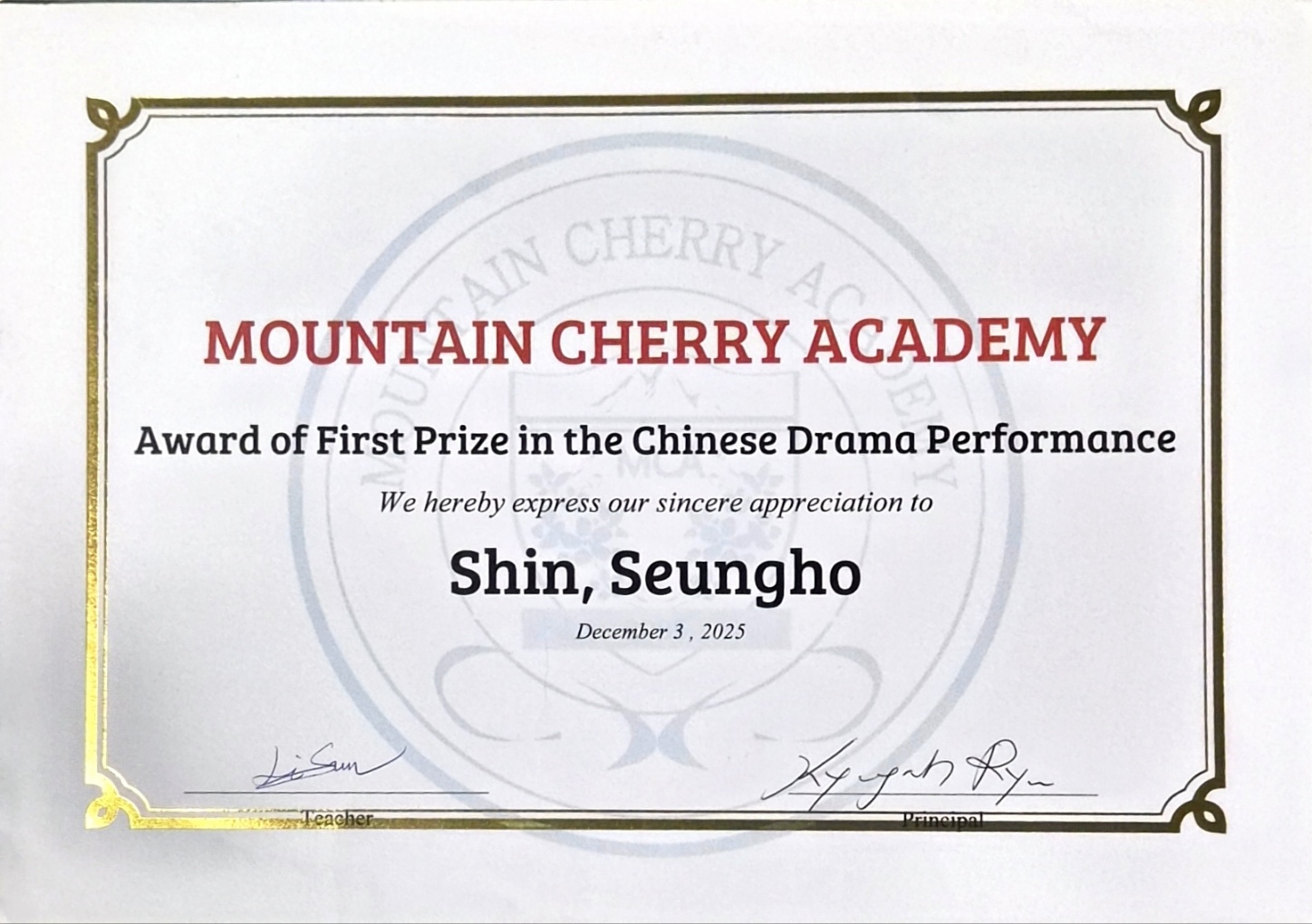
Chinese Drama Performance — First Prize
-
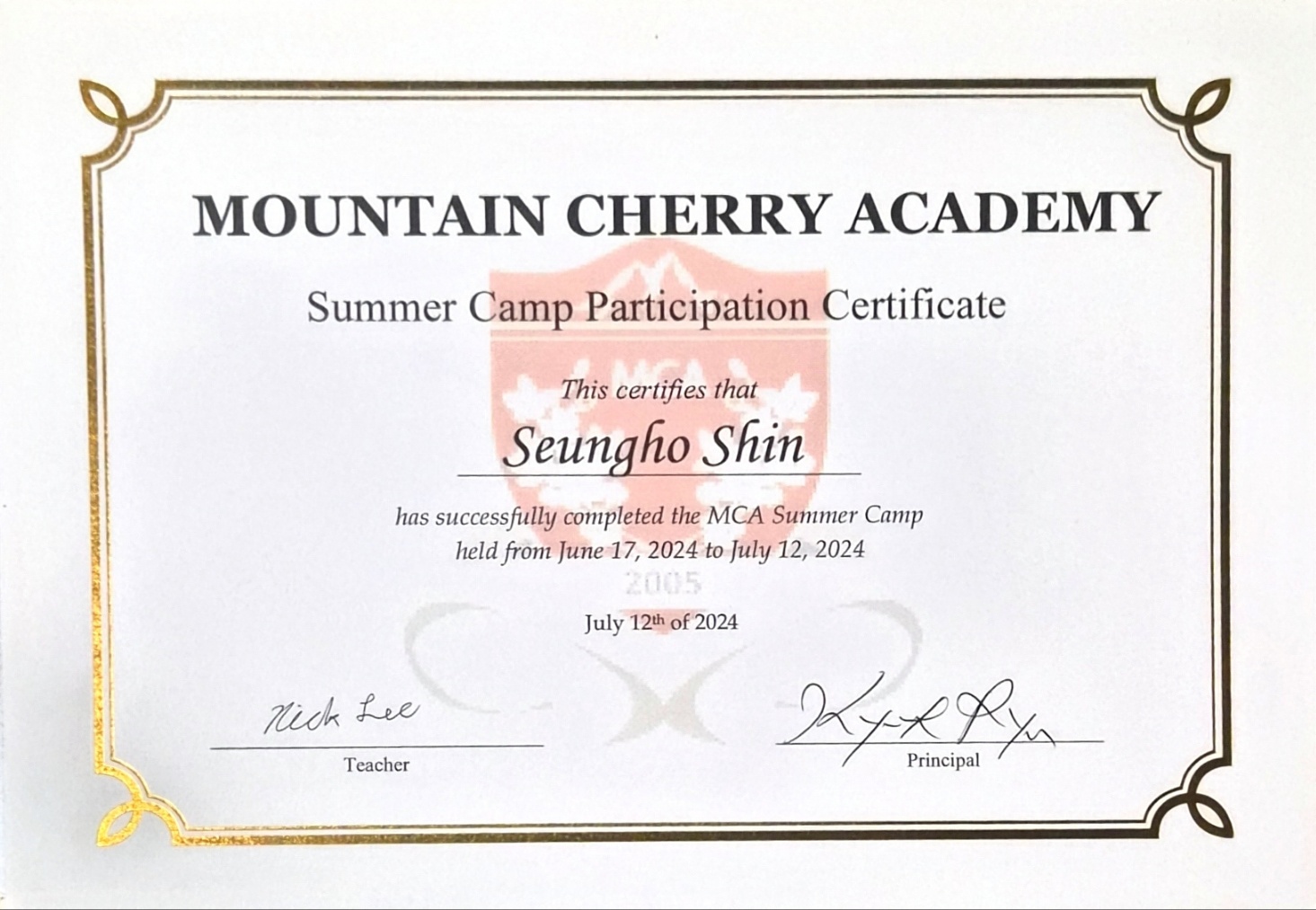
MCA Summer Camp (June 17 – July 12, 2024) — Participation Certificate
-
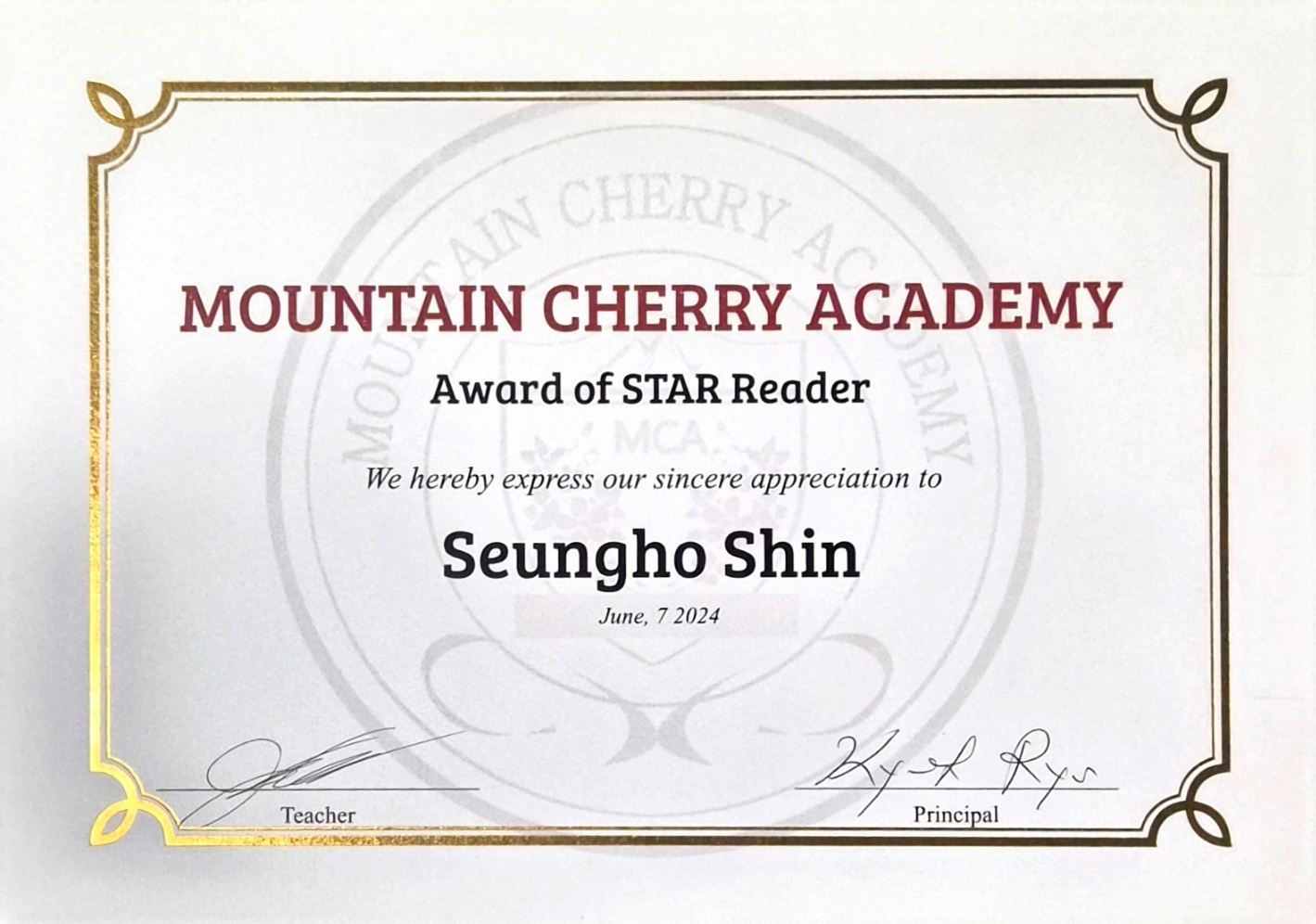
Award of STAR Reader
-
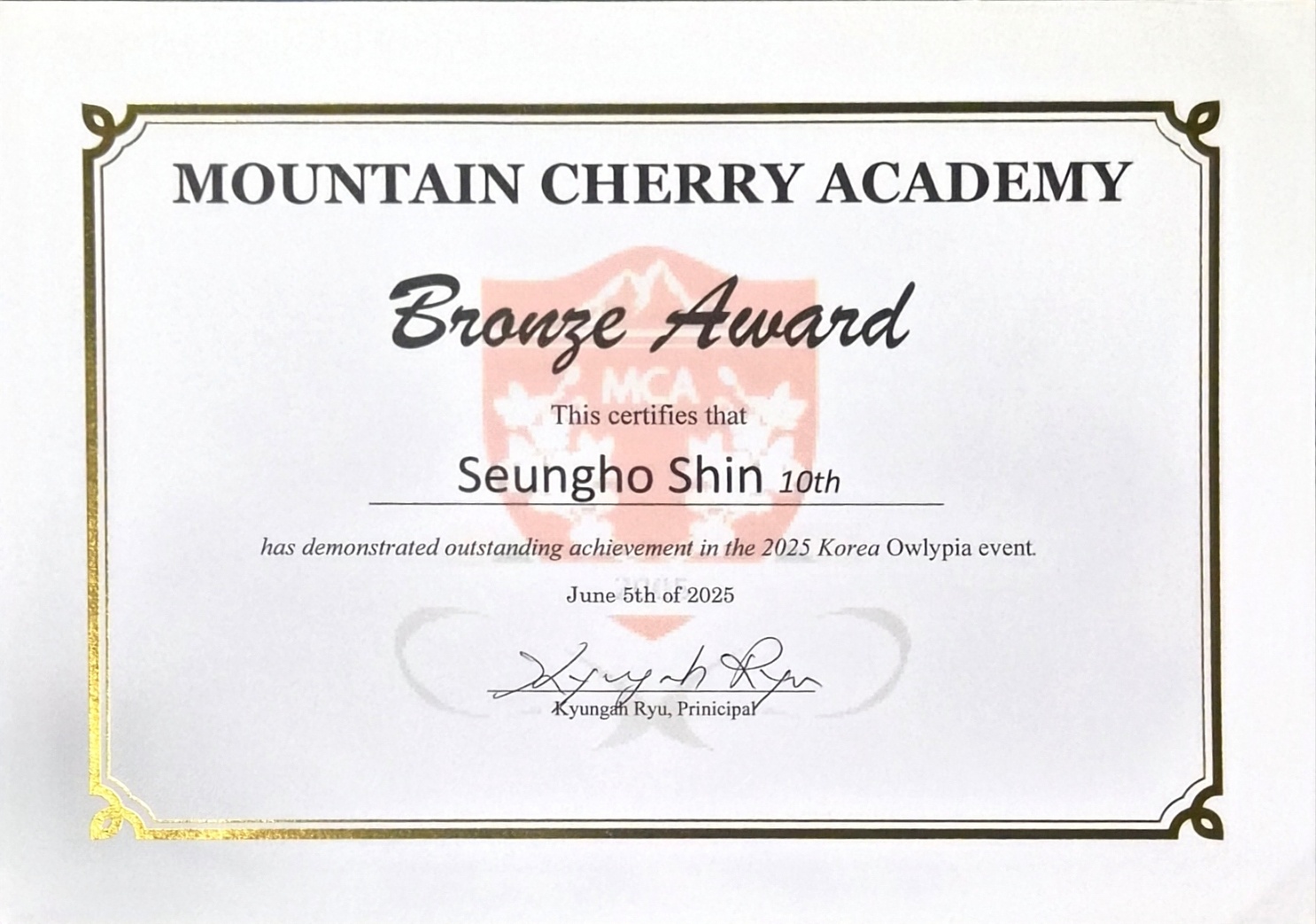
2025 Korea Owlypia — Bronze Award (10th grade)
-
Science Fair (High) — First Place